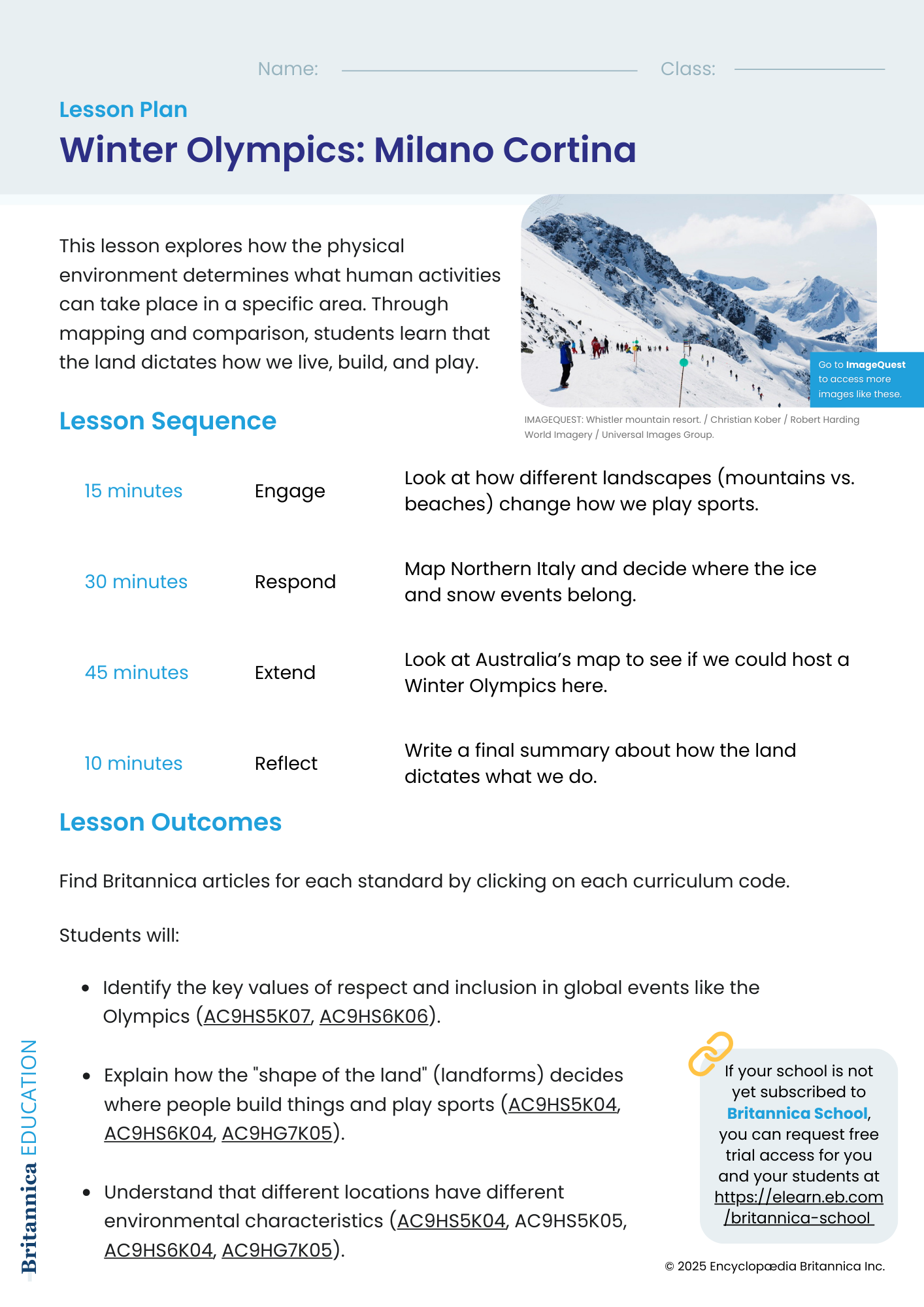
Winter Olympics

Milano Cortina

What’s Inside This Lesson

This lesson examines how landforms influence human activity. Students investigate the environments of Milan and Cortina to see how geography determines the placement of Winter Olympic events.


Lesson Outcomes

  • ACARA Version 9.0

    Students will:

    • Identify the key values of respect and inclusion in global events like the Olympics (AC9HS5K07, AC9HS6K06).
    • Explain how the “shape of the land” (landforms) decides where people build things and play sports (AC9HS5K04, AC9HS6K04, AC9HG7K05).
    • Understand that different locations have different environmental characteristics (AC9HS5K04, AC9HS5K05, AC9HS6K04, AC9HG7K05).


    Students can:

    • Locate Milan and Cortina on a map of Italy (AC9HS5S02, AC9HS6S02, AC9HG7S02).
    • Identify the physical differences between a flat city and a steep mountain (AC9HS5K04, AC9HS6K04, AC9HG7K05).
    • Complete a summary sentence explaining why geography matters to the Olympics (AC9HS5S05, AC9HS5S07, AC9HS6S05, AC9HS6S07, AC9HG7S05).
  • Victorian Curriculum Version 2.0

    Students will:

    • Identify the key values of respect and inclusion through the contributions of diverse groups (VC2HH6K09, VC2HH6K10).
    • Explain how specific geographical characteristics and landforms shape a place (VC2HG6K03, VC2HG8K12)
    • Understand the main characteristics of the geography of continents and the diversity of environments (VC2HG6K03, VC2HG6K06)


    Students can:

    • Locate, collect and represent information using maps and other sources (VC2HG6S02, VC2HG6S03, VC2HH6S03)
    • Interpret information to identify similarities and differences between places and features (VC2HG6S04, VC2HH6S07)
    • Develop evidence-based conclusions and explanations using geographical and historical concepts (VC2HG6S05, VC2HG6S07, VC2HH6S10)
  • NSW Curriculum

    Students will:

    • Examines global citizenship and how people organise, protect and sustainably use the environment, using geographical information (HS3-GEO-01)
    • Describes the origins and features of Australia’s democratic system of government and laws (HS3-DEM-01)
    • Creates written texts to communicate ideas and understanding about people, places and events of the past and the present (HS3-CWT-01)


    Students can:

    • Locate and represent cities, towns and communities in relation to other places in Australia and the world, using maps (HS3-GEO-01)
    • Observe, measure, collect and record geographical information to explain how places are organised (HS3-GEO-01)
    • Use varied sentences and multiple paragraphs with clear, coherent transition of ideas and a conclusion when explaining events (HS3-CWT-01)

Request Download

Please fill in this form to access a download link for the resource.